
Why Does My Dog Keep Licking Its Paws? Causes, Treatment and When to Worry

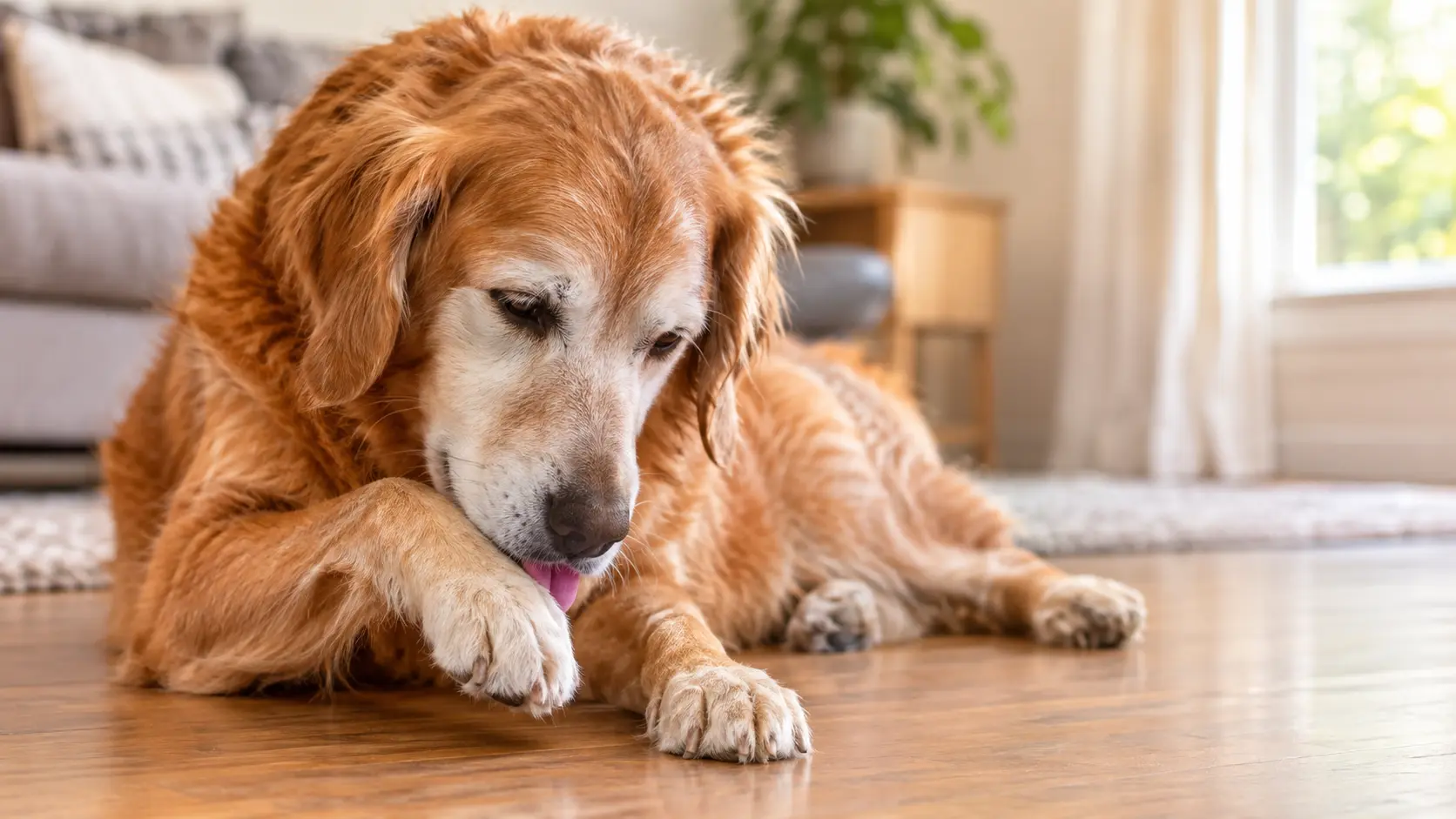
Why does your dog keep licking its paws? Learn about allergies, infections, injuries and pain, plus safe care tips and warning signs in senior dogs
By Dr. Waleed DVM · Last updated November 3, 2026
It is 2 a.m. The house is quiet, and the only sound is the one you cannot ignore: lick, lick, lick, slurp. Your dog is working on the same paw again. You say their name softly. They stop for ten seconds, then start up again. You lie there wondering whether this is just a habit or the start of something you should be worried about.
That worry is reasonable. Occasional licking is normal grooming, but paw licking that happens daily, wakes you at night, or focuses on one spot is usually your dog telling you something hurts or itches. The good news is that most causes are treatable once you know what you are dealing with. This guide walks you through each one, what to look for, what you can safely do tonight, and when it is time to call the vet.
The Short Answer
Dogs lick their paws mainly because of itch (allergies, often with a secondary yeast or bacterial infection), pain (an injury, or joint pain such as arthritis), parasites, or stress and boredom. In older dogs, hidden joint pain is a cause owners miss all the time. The licking itself is never the diagnosis. It is the symptom that tells you to look closer.
In This Guide
Is Paw Licking Ever Normal?
Yes. Dogs groom their paws after walks, after eating, and sometimes just to clean off something tasty. A few short licking sessions a day, where your dog is easy to interrupt, is nothing to worry about.
It becomes a problem when you notice any of these:
Licking or chewing happens many times a day, or goes on for long stretches
It wakes your dog (or you) at night
Your dog focuses on one paw or one joint
The fur around the paw is stained rusty brown or pink from saliva
You see redness, swelling, hair loss, scabs, or a sore spot
The paws smell musty, sour, or like corn chips
Your dog limps, flinches when you touch the paw, or seems stiff
If any of those sound familiar, keep reading. The cause matters, because the right fix for an allergy is completely different from the right fix for arthritis.
The 8 Most Common Causes of Paw Licking in Dogs
1. Allergies (the most common cause)
Allergies are one of the most frequently identified reasons for chronic paw licking. Dogs with environmental allergies (pollen, grass, dust mites, mould) often show it first on the feet, along with the ears, face, and belly. Dogs can also react to ingredients in their food.
Clue to watch for: Licking that worsens in certain seasons suggests environmental allergy, usually involving both front paws or all four. Licking that happens year-round, along with repeated ear infections or digestive upset, makes a food reaction more likely. Face rubbing and a red belly are also common companions.
One point worth knowing: there is no reliable blood, saliva, or hair test for food allergy in dogs. The accepted way to confirm it is an elimination diet trial using a prescription hydrolyzed or novel-protein diet, usually for 8 to 12 weeks, with no other treats or table scraps. Skipping the treats is the part most owners find hardest, and it is the part that decides whether the trial works.
2. Yeast and Bacterial Infections
Constant licking keeps the skin wet, and warm, damp skin is exactly what yeast (Malassezia) and bacteria love. These infections are often secondary: an allergy or other problem starts the itch, the licking creates the moisture, and the infection then makes the itch worse. That is the cycle that keeps many dogs licking for months. Veterinary dermatology sources note that around a third of dogs with atopic (environmental) allergy also have a concurrent Malassezia infection, and that yeast overgrowth is also linked to hormonal problems such as hypothyroidism.
Clue to watch for: A musty or “corn chip” smell, greasy or crusty skin between the toes, brown or rust-coloured discolouration of the claws and nail folds, redness, and sometimes sticky discharge. Bacterial infections tend to produce pus or crusts.
Diagnosis is simple and quick: your vet presses a piece of tape or a slide against the skin and examines it under a microscope (cytology). Treatment usually involves medicated antifungal and antibacterial washes or wipes, and sometimes oral medication. A systematic review of treatments found that the best-supported topical option was a shampoo containing 2% miconazole and 2% chlorhexidine, used twice weekly for three weeks. That is a vet-directed protocol, not a DIY one, because the underlying cause also has to be found or the infection tends to come back.
3. Injury or Something Stuck in the Paw
Dogs lick wounds instinctively. Small cuts, cracked pads, burns from hot pavement, torn nails, thorns, splinters, and grass seeds can all trigger it, and the wound can be too small to see at first glance.
Clue to watch for: Licking focused on one paw, often with limping, flinching when you touch it, or a small swelling or draining spot between the toes. A lump or draining spot between the toes can mean something is lodged under the skin, so do not squeeze or dig at it. Limping plus intense licking is a reason to have it examined rather than waiting.
4. Pain, Especially Arthritis (the one owners miss)
This is the cause I most want senior dog owners to know about. A dog cannot rub a sore joint the way you would rub a sore knee, so many dogs lick it instead. With arthritis, the licking is often aimed at the wrist (carpus) or ankle (hock) rather than the paw itself, and it can look like a paw problem when the real source is the joint above it. Pain elsewhere in the body, including the neck or spine, and even growths can also show up as licking of a limb.
Clue to watch for: Stiffness after rest, slowness getting up, reluctance to climb stairs or jump into the car, shorter walks, and licking that sticks to the same joint. If this sounds like your dog, read our guides on a dog who is stiff after lying down, a senior dog struggling to get up, and a dog who won’t jump anymore, as well as our main guide to arthritis in senior dogs.
5. Parasites
Fleas, mites (including demodex and sarcoptic mange), and ticks can make the feet itch. Flea allergy in particular can drive licking and chewing even when only a few fleas are present.
Clue to watch for: Itching elsewhere on the body, especially the base of the tail and back legs, tiny black specks (flea dirt) in the coat, or hair loss and crusting on the feet and legs.
6. Stress, Anxiety, and Boredom
Licking can become a self-soothing habit, much like nail-biting in people. Dogs that are alone for long periods, under-exercised, or anxious may lick as a way to cope.
Clue to watch for: The licking happens when your dog is alone, bored, or after a change in routine, and your dog can be easily distracted from it. Be careful, though: behavioural licking is a diagnosis of exclusion. In an older dog, always rule out pain, allergy, and infection first. Night-time licking in a senior can also be linked to age-related cognitive changes, which is another reason to involve your vet.
7. Dry, Cracked Pads and Contact Irritants
Hot or cold pavement, de-icing salt, floor cleaners, lawn treatments, and rough terrain can irritate the pads and skin between the toes. Dry seasons can also leave pads rough and sore.
Clue to watch for: Licking that begins soon after walks or after a particular surface or product, with pads that look dry, cracked, or inflamed.
8. Lick Granuloma (Acral Lick Dermatitis)
Sometimes the licking itself becomes the disease. When a dog licks the same spot, usually on the lower front leg, for long enough, the skin can become bald, thickened, raised, and ulcerated. This is called acral lick dermatitis or a lick granuloma. It often starts from an underlying cause such as allergy, joint pain, or boredom, then continues as a habit. It is more common in middle-aged to older dogs.
Clue to watch for: A bald, shiny, raised, often red or ulcerated patch just above the paw, with the surrounding hair stained from saliva. These lesions are stubborn. Treatment often takes weeks to months and focuses on stopping the licking, treating any infection, and finding the root cause, and recurrence is common. See your vet early rather than late.
Quick Guide: What the Clues Usually Point To
This table is a starting point for the conversation with your vet, not a diagnosis.
What you notice | Most likely direction |
|---|---|
Both front paws, worse in certain seasons, ear or belly itch | Environmental allergy |
Year-round licking with ear infections or loose stools | Food allergy or sensitivity |
Musty or corn-chip smell, brown nails, greasy skin | Yeast infection (often secondary to allergy) |
Pus, crusts, or sticky discharge between toes | Bacterial infection |
One paw only, with limping or a visible wound | Injury or foreign body |
Licking the wrist or ankle, stiff after rest, slow on stairs | Arthritis or joint pain |
Itch at the tail base, black specks in the coat | Fleas or other parasites |
Licks mostly when alone or bored, easy to distract | Stress or boredom (after medical causes are ruled out) |
Bald, raised, shiny sore above the paw | Lick granuloma |
Why Paw Licking in Senior Dogs Is Different
With a young dog, allergy is the first suspect. With a senior, the list gets longer, and the order changes. Here is what I would want you to keep in mind if your dog has a grey muzzle:
Pain comes first on the list. Osteoarthritis is very common in older dogs, and licking over a joint is one of the ways it hides. If the licking started alongside stiffness, slowing down, or reluctance to jump, a pain exam is the right first step, not an allergy shampoo.
Do not assume it is behavioural. It is easy to say an older dog is licking out of boredom or anxiety. That may be partly true, but medical causes need to be ruled out first.
Hormonal and whole-body conditions matter. Conditions such as hypothyroidism can make skin infections more likely, so recurring paw infections in an older dog deserve a deeper look.
New lumps or nail changes need checking. A new growth between the toes, a swollen toe, or a nail that has changed shape or colour should be examined rather than watched.
Night-time licking can have more than one cause. Discomfort that is harder to ignore when the house is quiet, anxiety, or cognitive changes can all play a part.
The practical takeaway: if your senior dog has started licking and you cannot point to a clear skin cause, book an exam and ask specifically about joint pain.
What to Do Tonight, Safely
You do not need to diagnose anything at 2 a.m. You just need to look, protect the skin, and avoid making it worse.
Take a calm look. With good light, gently spread the toes and check between them, around the nails, and across each pad. Look for cuts, swelling, redness, a stuck seed or thorn, and compare it with the other paws. Take a photo so you can track changes.
Remove only what is easy and obvious. If a loose bit of grit or a burr is on the surface, brush it off. If something is lodged, if your dog yelps, or if there is a deep wound, stop and call your vet.
Rinse gently. Use lukewarm water or plain saline to rinse off dirt and allergens.
Dry thoroughly. Pat dry, including between the toes. Leftover moisture feeds yeast and bacteria, and this step gets skipped more than any other.
Block access for now. A soft, well-fitting cone for short, supervised periods can protect irritated skin. Avoid leaving socks or wraps on unsupervised, because they can trap moisture and can be swallowed.
Write down what you see. Which paw, how often, what time of day, any new foods, products, or walking surfaces. This helps your vet far more than you might expect.
What to avoid
Human creams and ointments. Your dog will lick them off and swallow them. Some contain ingredients that are unsafe for dogs.
Hydrogen peroxide and anything that stings. It can damage healing tissue and make licking worse.
Home remedies on raw or broken skin. Vinegar mixtures and similar products sting and can make the skin worse.
Giving human medication without your vet. Doses and safety vary by dog, and some are dangerous. Ask your vet before giving anything.
Waiting for weeks. If it is not clearly improving in a few days, the cause needs to be found.
Home care soothes. It does not fix the cause. If the licking continues, it is a sign the underlying problem needs a proper diagnosis.
What Your Vet Will Do and How It Is Treated
Expect a thorough exam of the paws, joints, and skin, plus questions about timing, diet, and environment. Depending on what they find, your vet may recommend:
Skin cytology (tape or swab) to check for yeast and bacteria
Skin scrapings or hair tests to look for mites or ringworm
A parasite check and a review of your flea and tick prevention
Joint exam and X-rays if pain is suspected, particularly in older dogs
An elimination diet trial if food allergy is suspected
Allergy testing for environmental triggers, in some cases
Bloodwork to look for conditions such as hypothyroidism when infections keep recurring
Treatment is matched to the cause. That might mean medicated washes or wipes for infection, anti-itch medication for allergies such as Apoquel or Cytopoint, parasite control, pain management for arthritis, wound care for injuries, or behaviour and enrichment plans for stress. Allergies are usually managed rather than cured, so expect an ongoing plan. These medications are prescription treatments chosen by your vet for your individual dog.
One more practical tip: in some dogs with joint pain, your vet may suggest treating the pain and watching whether the licking changes. That response can itself help confirm the cause.
When to Worry: Red Flags
See a vet the same day if you notice:
Limping, or your dog refuses to put weight on the paw
A deep cut, heavy bleeding, or something clearly lodged in the paw
Rapid swelling, heat, pus, or a foul smell
Red streaks spreading up the leg
Your dog is lethargic, not eating, or in obvious pain
Book an appointment within a few days if:
Licking continues for more than a day or two without improvement
You see redness between the toes, brown staining, or a persistent odour
One paw is being licked much more than the others
Hair is thinning, or the skin looks darkened, thickened, or sore
Your senior dog licks a joint and is stiffer or slower than before
The problem keeps coming back after it seems to clear
When in doubt, call. Paws are small, and problems that start small can become infections or granulomas quickly when the licking never stops.
How to Prevent Paw Problems
Wipe and dry paws after walks. This removes allergens and moisture, especially between the toes.
Check paws weekly. Look at pads, nails, and the skin between the toes while you are relaxed on the sofa.
Keep nails and paw hair trimmed. Long nails and matted hair trap moisture and debris and can make walking uncomfortable.
Stay on top of flea and tick prevention year-round, as your vet advises.
Protect pads from extremes. Avoid hot pavement and de-icing salt, or use well-fitted boots.
Manage allergies early. Controlling the itch stops the lick-and-infection cycle before it starts.
Support joints in older dogs. Non-slip rugs on smooth floors, ramps, gentle regular exercise, and weight control help, along with any pain medication your vet prescribes.
Give your dog something to do. Daily walks, sniffing games, and food puzzles reduce boredom licking.
Key Takeaways
Occasional paw licking is normal. Frequent, intense, one-sided, or night-time licking is not.
The most common causes are allergies, infections, injuries, pain, parasites, and stress.
In senior dogs, rule out joint pain early. Licking over a wrist or ankle can be arthritis, not skin disease.
Rinse, dry, and protect the paw tonight, and avoid human creams, peroxide, and anything that stings.
Limping, wounds, swelling, or pus need a prompt vet visit.
Treat the cause, not just the licking.
This article is for general education and is not a substitute for a veterinary exam. Your dog’s paws, joints, and skin need to be examined in person to find the cause. If you are worried, contact your vet. If your dog is in severe pain, cannot walk, or you see signs of a spreading infection, seek care right away.
🩹 Veterinary Disclaimer
This article is written by Dr. Waleed, DVM for general educational purposes only. It does not constitute a veterinary consultation or diagnosis for your specific pet. Always consult a veterinarian before making health decisions for your dog. If your pet is in distress, contact your vet or emergency animal clinic immediately.
Frequently Asked Questions
Why does my dog lick its paws all night?
Is it normal for my dog to lick its paws every day?
My dog is licking only one paw. Should I be worried?
My senior dog suddenly started licking his paws. Could it be arthritis?
Why do my dog's paws smell like corn chips and have brown stains?
Can I put cream, coconut oil, or Benadryl on or in my dog to stop the licking?
Should I put a cone or a sock on my dog to stop the licking?
Could my dog's food be causing the paw licking?
How long does it take for the licking to stop once it is treated?
When is paw licking an emergency?
Dr. Waleed, DVM
Veterinarian · Grey Muzzle Squad
A veterinarian with a deep focus on companion animal health. Founded this blog to give pet owners access to real, clinical veterinary knowledge ??? without the guesswork.
Read full bio →Comments
Loading comments...
Leave a Comment
More to Read
View All
Why Is My Dog Stiff After Lying Down? Here's What It Really Means
Your dog looks stiff for the first few steps after resting, then walks fine? A vet explains exactly what this pattern means and when to worry

Why Is My Dog Pacing at Night? Dementia, Anxiety & Other Causes
Is your senior dog pacing, panting or confused at night? Learn about canine dementia, anxiety and restlessness.
Why Is My Dog So Itchy? Causes, Treatment & When to See a Vet
Why Is My Old Dog So Itchy All of a Sudden?

Why Is My Dog Drinking So Much Water? Causes & When to Worry
Is your senior dog suddenly drinking a lot of water? A vet explains kidney disease, diabetes, Cushing's and every other cause

Why Is My Dog Breathing Fast While Resting? Causes & What to Do
Is your dog breathing fast while resting? Learn the possible causes, how to check your dog's breathing rate and when it's an emergency.
Dog Arthritis Injections: Every Option Explained and Which Is Safest
Confused about dog arthritis injections? Dr. Waleed explains every option — Librela, Adequan, steroids, PRP — what each one does, which is safest, and how to choose.