
Why Is My Dog Breathing Fast While Resting? Causes & What to Do

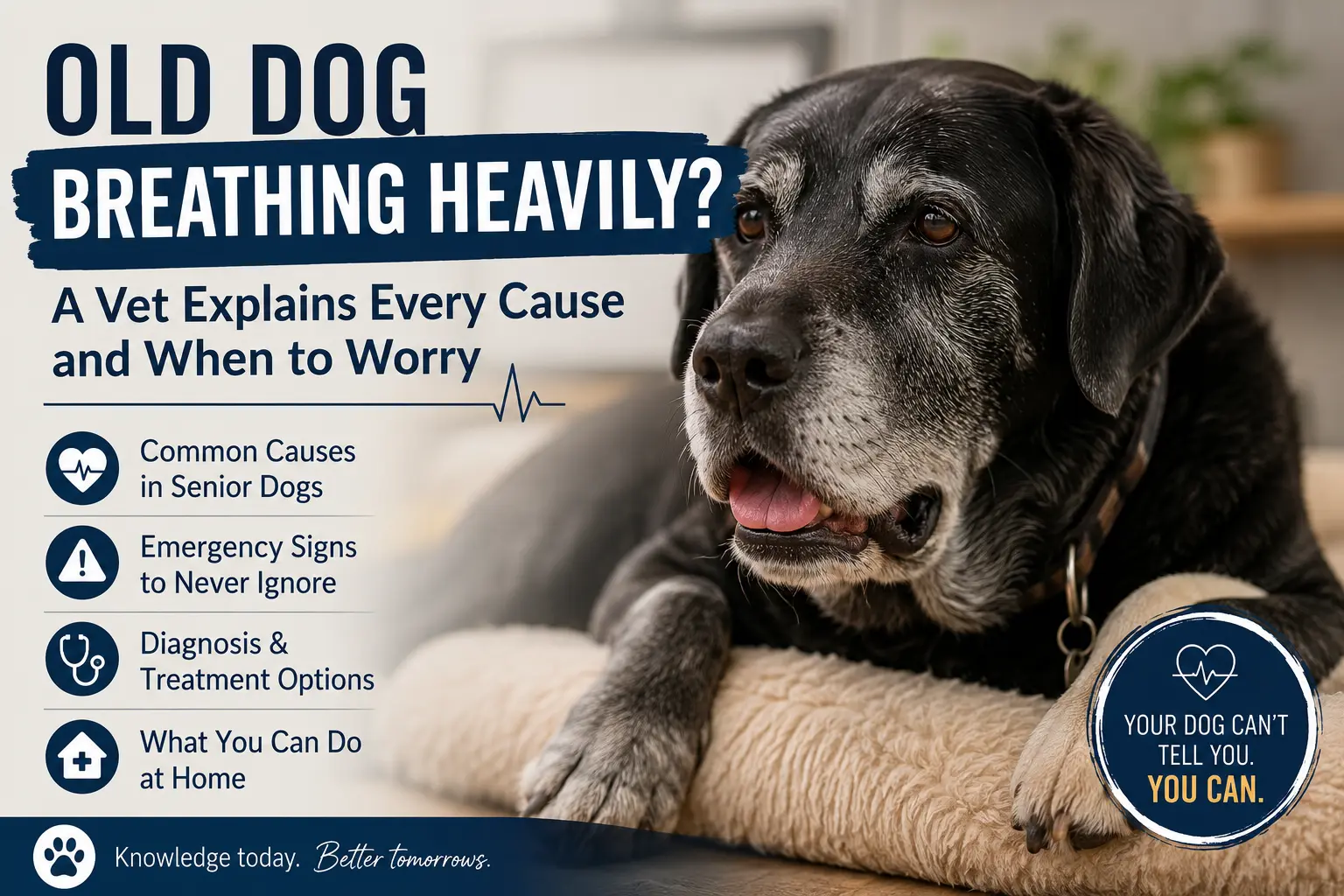
Is your dog breathing fast while resting? Learn the possible causes, how to check your dog's breathing rate and when it's an emergency.
You are watching your dog lie on their bed — and something about the way they are breathing does not look right. Too fast. Too much effort. You can see their chest or belly moving with every breath in a way you do not remember noticing before. And they are not hot, they have not been exercising, and there is no obvious reason for it.
This is one of the most unsettling things to notice in a senior dog, and it is one of the signs I take most seriously when owners describe it to me. Rapid or laboured breathing in an older dog at rest almost always means something specific is happening — and some of those things need attention today, not next week.
In this guide I am going to give you the tools to assess what you are seeing, walk you through every significant cause of fast or heavy breathing in senior dogs, show you the exact signs that make this an emergency right now, and explain what happens when your vet investigates it properly.
First — How to Count Your Dog's Breathing Rate Right Now
Before anything else, count the breaths. This takes thirty seconds and gives you an objective number that is far more useful than a general sense that something seems wrong.
Wait until your dog is lying down and completely relaxed — not just after a walk, not after eating, ideally while they are sleeping or resting quietly. Watch their chest or belly rise and fall. Count each complete rise-and-fall cycle as one breath. Count for thirty seconds and multiply by two. This gives you breaths per minute.
A healthy dog at rest breathes between 15 and 30 times per minute. Senior dogs may breathe slightly faster, sometimes reaching 35 breaths per minute at rest. Anything consistently above this range in a dog who is calm, cool, and not recently exercised is worth taking seriously.
If your dog has an increased respiratory rate — usually greater than 30 breaths per 60 seconds — when sleeping or resting, this is a medical emergency. There may be an underlying issue with your dog's lungs, heart, or airways.
Write the number down. Time it again an hour later. If the number is high and not improving, or if you see any of the emergency signs I list below, contact your vet today.
The Difference Between Fast Breathing and Laboured Breathing
This distinction can help you judge urgency before you even call the vet.
Fast breathing means a higher than normal respiratory rate — more breaths per minute than expected — but the breaths themselves may still look relatively effortless. This can indicate a problem, but the dog may be compensating adequately for now.
Laboured breathing is different and more urgent. Signs of laboured or distressed breathing include:
The belly visibly heaving with each breath — using abdominal muscles to force air in or out
The neck stretched forward and the head lowered
The elbows held out away from the body — a stance dogs take to open the chest as much as possible
Nostrils flaring
Breathing with the mouth open when the dog is resting and not hot
Audible sounds with each breath — wheezing, crackling, rattling, or a wet-sounding noise
Gums that look pale, grey, or have a bluish tinge instead of their normal pink
If your dog is nose-breathing heavily while at rest or is experiencing laboured breathing, it is a medical emergency. If the abdomen is pushing as your dog breathes out, it could mean they are having trouble removing air from their lungs.
Blue or grey gums in particular — caused by insufficient oxygen reaching the tissues — require emergency veterinary attention immediately. Do not wait to see if they improve.
Why Senior Dogs Are More Vulnerable to Breathing Problems
When a senior dog begins breathing rapidly or with more effort, there is a wider range of serious potential causes compared to a younger dog experiencing the same symptom. Age alone does not explain breathing changes and should never be used as a reason to delay veterinary evaluation.
As dogs age, their heart and lung function naturally becomes less efficient. The heart muscle may weaken, the lungs become less elastic, and the immune system is less able to fight off respiratory infections. Any of these changes can tip a dog from managing adequately to struggling — sometimes quite quickly.
The Most Common Causes of Fast or Heavy Breathing in Senior Dogs
Heart disease — the most common cause in older dogs
Heart disease is one of the most common causes of rapid breathing in senior dogs. As the heart loses its ability to pump blood efficiently, fluid can accumulate in and around the lungs. This condition, known as pulmonary oedema, makes breathing effortful and fast even at rest. Dogs with congestive heart failure often show a combination of rapid breathing, a persistent cough, exercise intolerance, and abdominal distension in later stages.
The pattern with heart disease is distinctive: the fast breathing tends to be worse when the dog is lying down — because fluid redistributes in the chest — and often improves slightly when the dog sits up or stands. You may also notice a persistent soft cough, particularly at night, and the dog becoming tired much more quickly on walks than they used to.
The clue to watch for: fast breathing at rest combined with a cough, reduced exercise tolerance, and sometimes a pot-bellied appearance as fluid accumulates in the abdomen.
Lung disease — pneumonia, bronchitis, pulmonary fibrosis
Several conditions affecting the lungs and airways directly cause rapid breathing in senior dogs. Chronic bronchitis involves persistent inflammation of the airway walls, leading to narrowing, excess mucus production, and increased breathing effort. Pulmonary fibrosis — more common in certain breeds such as West Highland White Terriers — involves progressive scarring of the lung tissue that reduces its ability to expand and exchange oxygen effectively. Pneumonia, which can develop following an infection or aspiration of food or liquid, is another cause of rapid and laboured breathing that requires prompt treatment.
Bacterial or viral infections affecting the lungs or airways can cause rapid and laboured breathing in older dogs whose immune systems are less robust. Pneumonia in particular can develop quickly and cause significant respiratory distress. Other signs often accompanying infection include nasal discharge, reduced appetite, fever, and lethargy.
Fluid around the lungs (pleural effusion)
Pleural effusion refers to the accumulation of fluid in the space between the lungs and the chest wall. This fluid compresses the lungs and makes it physically difficult for them to expand fully, causing rapid and shallow breathing. Dogs with pleural effusion often breathe with their elbows held out from the body and their neck extended in an effort to maximise airway opening. They may also refuse to lie down, preferring to sit or stand to keep the chest open.
Pleural effusion can be caused by heart disease, infection, cancer, or low protein levels in the blood. It is treated by draining the fluid directly from the chest — a procedure called thoracocentesis — which often provides immediate and dramatic relief. But the underlying cause also needs to be found and addressed.
Pain
Pain is an underrecognised cause of rapid breathing in senior dogs. When a dog is experiencing significant discomfort — whether from arthritis, an internal injury, an abdominal condition, or post-surgical recovery — their breathing rate increases as part of the physiological stress response. This form of rapid breathing is often accompanied by restlessness, a reluctance to settle, changes in posture, and other behavioural signs of discomfort.
A senior dog with significant arthritis pain who is panting heavily at night is showing you that the pain is not adequately managed. This is one of the most common situations I see in older dogs — the panting is the pain signal. Once pain is properly controlled, the breathing often normalises within days.
The clue: fast breathing or panting accompanied by restlessness, reluctance to lie in one position, unusual posture, sensitivity when touched in certain areas, or a dog who gets up repeatedly and cannot settle.
Anaemia
Anaemia means the blood contains fewer red blood cells than normal — meaning less capacity to carry oxygen around the body. To compensate, the body breathes faster to try to extract more oxygen with each breath. Senior dogs can develop anaemia from various causes including chronic disease, immune-mediated destruction of red blood cells, gastrointestinal bleeding, or bone marrow problems.
The clue: pale gums alongside fast breathing, lethargy, and weakness. Anaemic dogs often look tired and washed out. A complete blood count will diagnose this quickly.
Cushing's disease
Excess cortisol production in Cushing's disease causes a range of effects including increased respiratory rate and persistent panting. This was covered in the panting guide elsewhere on this blog — the panting associated with Cushing's is often constant and disproportionate to temperature or activity, and typically accompanied by increased thirst, increased appetite, a pot-bellied appearance, and skin and coat changes.
Tracheal collapse
Tracheal collapse is a condition in which the cartilage rings supporting the trachea weaken and cause the airway to narrow during breathing. It is particularly common in small and toy breeds and tends to worsen with age. Dogs with tracheal collapse often produce a distinctive honking cough and may breathe rapidly when the airway is compromised. The breathing difficulty is often worse with excitement, pulling on a collar, or in warm weather.
Tumours in the chest
Tumours within the chest cavity — whether primary lung tumours or metastatic spread from cancer elsewhere in the body — can impair respiratory function as they grow. Fast or laboured breathing that develops gradually over weeks, particularly in a dog with a known cancer diagnosis, can indicate lung involvement and needs urgent assessment.
Pulmonary hypertension
Pulmonary hypertension refers to abnormally high blood pressure within the vessels supplying the lungs. This forces the heart to work harder to push blood through the lungs and can result in fluid accumulation, reduced oxygen exchange, and rapid or laboured breathing. It often develops secondary to other conditions including heart disease, lung disease, or blood clotting disorders.
Anxiety and stress
While anxiety can cause fast breathing — during thunderstorms, fireworks, vet visits, or car journeys — it should not be assumed to be the cause without ruling out the physical causes above. A senior dog who develops new anxiety-related breathing does so because something has changed. Cognitive decline can increase anxiety significantly in older dogs, and sensory loss — hearing or vision — can make previously manageable situations feel threatening. But if anxiety seems the most likely explanation, it still needs management, not dismissal.
The Resting Respiratory Rate — Your Most Useful Home Monitoring Tool
For dogs with heart disease, one of the most valuable things you can do at home is monitor the resting respiratory rate regularly. To check your dog's breathing rate, watch their chest rise and fall for 30 seconds, then multiply by two. The best time to count is when they are relaxed or sleeping.
Texas A&M University College of Veterinary Medicine recommends that owners of dogs with heart disease count their dog's sleeping respiratory rate daily and contact their vet if the rate is consistently above 30 breaths per minute, or if it increases significantly from their established baseline. Many vets now ask owners to do this as a routine monitoring measure — a rise in resting respiratory rate is often the earliest warning sign that heart failure is worsening before other symptoms become obvious.
Keep a simple log — date, time, rate. This record is one of the most genuinely useful things you can bring to a vet appointment.
When Is Fast Breathing an Emergency?
Go to an emergency vet immediately — right now, not in the morning — if:
Gums look pale, grey, blue, or white instead of their normal pink
Your dog is visibly struggling to breathe — using their belly, neck stretched forward, elbows out
Breathing is audibly abnormal — crackling, wheezing, bubbling, or rattling sounds
Your dog will not or cannot lie down
Breathing rate is above 40 per minute at rest
Your dog has collapsed or cannot stand
Fast breathing came on suddenly with no obvious cause
Call your vet first thing in the morning if:
You have counted the rate and it is consistently above 30 at rest
Your dog's breathing seems faster than usual but they are not in obvious distress
The breathing is accompanied by a cough, lethargy, or reduced appetite
This is a new change you have noticed over the past few days
How a Vet Investigates Fast Breathing in a Senior Dog
When you bring your dog in for breathing concerns, your vet is trying to answer one question: where is the problem — heart, lungs, blood, pain, or something else? The investigation is usually systematic.
Auscultation — listening with a stethoscope
Your vet will listen carefully to the heart and lungs. Heart murmurs, abnormal heart rhythms, and abnormal lung sounds — crackles, wheezes, or reduced sound in one area — are often detected at this stage and immediately narrow the list of likely causes.
Chest X-ray
A chest radiograph is usually the most informative single test for a dog with breathing difficulty. It shows the size and shape of the heart, the presence of fluid in or around the lungs, the appearance of the lung tissue itself, and any masses in the chest cavity. Results are often available within minutes and can completely change the direction of treatment.
Echocardiogram
If heart disease is suspected, an echocardiogram — an ultrasound of the heart — shows exactly how the heart is pumping, which valves are affected, and whether fluid is accumulating. This is the gold standard for diagnosing and staging heart disease.
Blood tests
A full blood panel checks for anaemia, infection, organ disease, and other systemic causes. An NT-proBNP blood test — a cardiac biomarker — can help distinguish heart disease from lung disease when the clinical picture is unclear.
Pulse oximetry
A small probe placed on the ear or paw measures blood oxygen saturation non-invasively. Values below 95% in a resting dog confirm that the breathing difficulty is affecting oxygen delivery — adding urgency to the situation.
What You Can Do at Home While You Arrange a Vet Appointment
Keep them calm and cool
Excitement and heat both increase breathing rate significantly. A dog with a breathing problem needs a calm, cool, well-ventilated environment. Avoid stairs, jumping, and exertion. If the weather is warm, move them to the coolest room in the house and ensure airflow.
Count and record the breathing rate
Note the rate every hour while you are waiting. If it is increasing, this is a reason to escalate to an emergency visit rather than waiting for a morning appointment.
Do not give any medication without veterinary advice
Human medications including aspirin, ibuprofen, and decongestants are not safe for dogs with breathing problems and may make things significantly worse. Wait for your vet's guidance.
Note all accompanying signs
Write down everything you have noticed alongside the fast breathing — whether there is a cough, when the breathing is worst, whether the dog will lie flat or prefers to sit up, any changes in energy or appetite, and what the gums look like. This information is directly useful to your vet and can speed up diagnosis.
A Final Word from Dr. Waleed
Breathing is not something your dog's body does casually. When an older dog is breathing faster or harder than normal at rest — without heat, without exercise, without obvious cause — their body is working harder than it should have to. That is never something to observe for a few more days and see.
The good news is that many of the causes I have described here are very treatable once identified. Congestive heart failure can be managed with medication that allows many dogs to continue living comfortably for months to years after diagnosis. Pneumonia responds to antibiotics. Anaemia has its own treatment depending on the cause. Pain can be controlled. Fluid can be drained.
What makes the difference in almost every case is how quickly the cause is found. Count the breaths. Check the gums. Know the emergency signs. And pick up the phone.
Frequently Asked Questions
My old dog is breathing fast while resting — is this an emergency?
It depends on the rate and what else you are seeing. Count the breaths — watch the chest rise and fall for 30 seconds and multiply by two. If the rate is consistently above 30 breaths per minute in a relaxed, resting dog, contact your vet today. If the rate is above 40, or if the gums look pale, grey, or blue, or if your dog is visibly struggling to breathe — using the belly, elbows out, neck stretched — go to an emergency vet immediately. Do not wait until morning if these signs are present.
Why is my senior dog breathing fast when doing nothing?
Fast breathing at rest in a senior dog without an obvious trigger — no heat, no exercise, no excitement — almost always has a medical cause. The most common ones are heart disease causing fluid in or around the lungs, a lung condition such as pneumonia or bronchitis, pain from arthritis or another source, anaemia, Cushing's disease, or in some cases a chest tumour. Age alone does not cause fast breathing. There is always a reason, and most of those reasons are identifiable and treatable with a proper veterinary assessment.
What does it mean when a dog breathes fast while sleeping?
Brief, rapid breathing during deep sleep — often accompanied by twitching or paddling — is usually normal dreaming. It is short-lived and stops when the dog moves into a lighter sleep phase. What is not normal is a consistently elevated breathing rate throughout sleep — counted over a full minute while the dog is genuinely settled and still. If your dog's sleeping breathing rate is consistently above 30 per minute every time you check, this needs veterinary investigation. Heart disease is one of the most common causes of elevated sleeping respiratory rate in older dogs.
How do I tell the difference between normal panting and something serious?
Normal panting has an obvious trigger — heat, exercise, excitement, stress — and resolves once that trigger is removed. The dog's gums stay pink, they settle comfortably, and they are otherwise behaving normally. Concerning breathing lacks an obvious trigger, persists at rest, may be accompanied by visible effort such as belly movement or elbows held out, may produce abnormal sounds, and may be associated with pale or blue gums. Any breathing that seems effortful, is accompanied by unusual sounds, or comes with pale or discoloured gums needs same-day veterinary attention.
Could my senior dog's fast breathing be caused by pain?
Yes, absolutely — and this is one of the most commonly missed causes. Pain triggers a physiological stress response that increases breathing rate. A dog with significant unmanaged arthritis, internal pain, or abdominal discomfort may breathe fast or pant heavily, particularly at night when the house is quiet and there are no distractions from the discomfort. The clues that pain is involved: the dog cannot settle, changes position frequently, is restless, or shows sensitivity when touched in certain areas alongside the fast breathing. Effective pain management usually produces a rapid improvement in the breathing pattern.
What is a normal breathing rate for a senior dog?
A healthy resting adult dog breathes between 15 and 30 times per minute. Senior dogs may be at the slightly higher end of this range. To check, watch your dog's chest rise and fall for 30 seconds while they are completely relaxed or sleeping, then multiply by two. It is worth checking this regularly once your dog reaches senior age — about seven years or older for most breeds — so you know their individual normal baseline. A consistent increase from that baseline, even if still within the general range, is worth mentioning to your vet.
My senior dog's breathing is fast but they seem otherwise fine — do I still need to see a vet?
Yes. Many serious causes of fast breathing in older dogs — including early congestive heart failure and early lung disease — can present with elevated breathing rate as the only noticeable sign for weeks or months before other symptoms develop. A dog who seems otherwise bright, eating, and moving normally but has a consistently elevated resting respiratory rate is showing you the early warning sign of something that needs to be found and managed. Catching heart disease or lung disease early gives far more treatment options and generally a much longer comfortable life than waiting until the dog is obviously struggling.
What will the vet do for a dog breathing fast?
Your vet will start by listening to the heart and lungs with a stethoscope — abnormal sounds here often immediately narrow the likely cause. A chest X-ray is usually the next step and is often the most informative single test — it shows the size of the heart, fluid in or around the lungs, and the state of the lung tissue. Blood tests check for anaemia, infection, and organ disease. An echocardiogram (heart ultrasound) confirms and stages heart disease. Pulse oximetry checks blood oxygen levels. Depending on what is found, treatment may begin the same day — diuretics for fluid, antibiotics for infection, or pain management if pain is the cause.
Ask Dr. Waleed
Worried about your senior dog's breathing? Send Dr. Waleed a message — I read every question and answer as many as I can.
Related Posts
🩹 Veterinary Disclaimer
This article is written by Dr. Waleed, DVM for general educational purposes only. It does not constitute a veterinary consultation or diagnosis for your specific pet. Always consult a veterinarian before making health decisions for your dog. If your pet is in distress, contact your vet or emergency animal clinic immediately.
Frequently Asked Questions
My old dog is breathing fast while resting — is this an emergency?
Why is my senior dog breathing fast when doing nothing?
What does it mean when an old dog breathes fast while sleeping?
How do I tell the difference between normal panting and something serious?
Could my senior dog's fast breathing be caused by pain?
What is a normal breathing rate for a senior dog?
My senior dog's breathing is fast but they seem otherwise fine — do I still need to see a vet?
What will the vet do for a dog that is breathing fast?
Dr. Waleed, DVM
Veterinarian · Grey Muzzle Squad
A veterinarian with a deep focus on companion animal health. Founded this blog to give pet owners access to real, clinical veterinary knowledge ??? without the guesswork.
Read full bio →Comments
Loading comments...
Leave a Comment
More to Read
View All
Why Is My Dog Stiff After Lying Down? Here's What It Really Means
Your dog looks stiff for the first few steps after resting, then walks fine? A vet explains exactly what this pattern means and when to worry

Why Is My Dog Pacing at Night? Dementia, Anxiety & Other Causes
Is your senior dog pacing, panting or confused at night? Learn about canine dementia, anxiety and restlessness.

Why Is My Dog So Itchy? Causes, Treatment & When to See a Vet
Why Is My Old Dog So Itchy All of a Sudden?

Why Is My Dog Drinking So Much Water? Causes & When to Worry
Is your senior dog suddenly drinking a lot of water? A vet explains kidney disease, diabetes, Cushing's and every other cause
Dog Arthritis Injections: Every Option Explained and Which Is Safest
Confused about dog arthritis injections? Dr. Waleed explains every option — Librela, Adequan, steroids, PRP — what each one does, which is safest, and how to choose.

Librela injection for dogs: side effects, how long it takes, pros and cons
Is Librela safe for your dog? Dr. Waleed covers side effects, how long it takes to work, pros and cons, and what the FDA data actually shows.